
Imagine you are writing a quick message to a colleague before a meeting starts. You have one extra detail to share, but it does not fit naturally into the main conversation. Instead of creating a long explanation, you type “BTW, the client confirmed the schedule.” This small abbreviation has become common in modern communication because it helps people add information quickly without interrupting the flow of a conversation.
BTW means “by the way.” It is a widely used informal abbreviation that introduces an additional comment, related thought, reminder, or piece of information. While it is efficient and familiar in digital communication, understanding its tone and choosing the right alternatives can improve clarity and professionalism. In workplace communication, academic writing, and cross-cultural conversations, the choice between “BTW” and a more formal phrase can influence how your message is received.
What Does “BTW” Mean?
BTW means “by the way,” a phrase used to introduce an additional piece of information, a side comment, a reminder, or a related thought during a conversation. BTW is commonly used in text messages, online chats, emails, and social media because it allows people to add information quickly without changing the main topic.
The core purpose of BTW is to smoothly introduce something that is not the main focus but is still worth mentioning. It can be used to share updates, ask questions, make casual observations, or provide extra context.
Common situations where people use BTW include:
- Adding a reminder in a conversation
- Mentioning an important detail after discussing the main topic
- Introducing a related idea
- Sharing casual information with friends or coworkers
- Making digital communication shorter and faster
For example:
“BTW, the report deadline has moved to Friday.”
Here, “BTW” signals that the deadline update is an additional point rather than the main subject of the conversation.
Origin & History of “BTW”
The phrase “by the way” has existed in English for centuries as a conversational expression used to introduce a new thought or additional information. The abbreviation BTW developed much later with the growth of digital communication.
During the early days of internet chat rooms, forums, and instant messaging in the 1990s, users created abbreviations to save typing time and communicate faster. Similar shortcuts such as “LOL” (laugh out loud), “BRB” (be right back), and “FYI” (for your information) became popular during this period.
BTW became especially common because it represented a natural spoken phrase in a shorter digital form. As texting, smartphones, workplace messaging platforms, and social media expanded, BTW became recognized globally as a casual communication shortcut.
Over time, its meaning has remained consistent, but its perception has changed. Earlier, it was mainly associated with personal online conversations. Today, many professionals use it in internal workplace chats, although it is still considered informal compared with expressions like “additionally,” “as a side note,” or “I would also like to mention.”
Synonyms & Alternatives by Tone
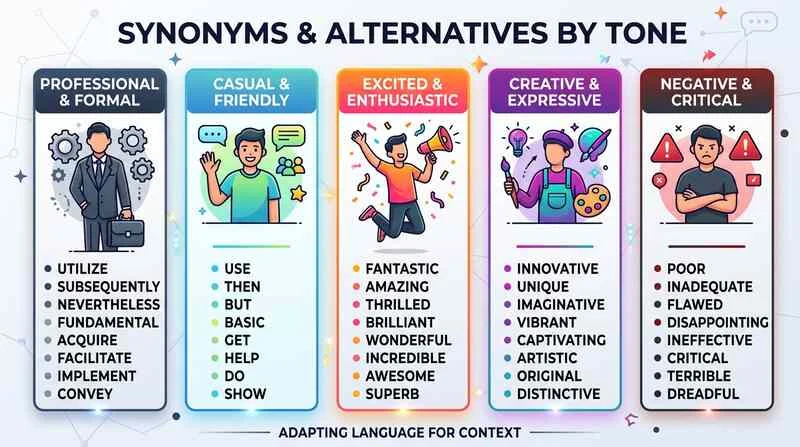
Choosing the right alternative to BTW depends on the situation, audience, and desired level of formality. Some alternatives sound professional and structured, while others maintain a friendly conversational style.
Professional & Neutral Alternatives
- Additionally
- Furthermore
- Moreover
- I would also like to mention
- Another point to consider
- It is worth noting
- On a related note
- As a side note
- I should mention
- For your information
Polite & Supportive Alternatives
- Just to let you know
- I wanted to mention
- I thought you might like to know
- I’d like to add
- One more thing
- A quick reminder
- I also wanted to share
- Before I forget
Encouraging & Reassuring Alternatives
- Just a quick update
- I wanted to keep you informed
- The good news is
- One helpful detail is
- Something else to keep in mind
- Another thing that may help
- I thought this might be useful
Casual, Playful & Idiomatic Alternatives
- Oh, by the way
- Speaking of which
- Random thought
- Side note
- Quick thing
- Almost forgot
- Funny enough
- Just saying
- Small detail
- Before I forget
When Should You Use “BTW”?
BTW works best when the communication style is relaxed, fast, and conversational. It is especially effective in digital environments where brevity matters.
Professional Settings
In workplaces, BTW can be acceptable in:
- Internal team chats
- Informal conversations with coworkers
- Quick updates through messaging apps
- Friendly communication between familiar colleagues
Example:
“BTW, I updated the presentation slides with the latest numbers.”
This sounds natural in a team chat where everyone understands the communication style.
However, it may not be suitable for formal emails to clients, executives, or external partners.
Casual Conversations
BTW is very common in everyday communication:
- Text messages
- Social media comments
- Online discussions
- Personal emails
- Group chats
Example:
“BTW, are you still coming to the event tomorrow?”
It feels friendly and effortless.
Writing, Presentations, and Digital Communication
BTW is useful when:
- The audience expects informal language
- The platform encourages short messages
- Speed is more important than formality
It is commonly seen on:
- Slack
- Discord
- Social media platforms
For articles, reports, academic writing, and official documents, a clearer alternative is usually better.
When Should You Avoid “BTW”?
Although BTW is widely understood, there are situations where avoiding it improves professionalism and clarity.
Overly Formal Situations
Avoid BTW in:
- Business proposals
- Legal documents
- Academic papers
- Official reports
- Client-facing communication
Instead of:
“BTW, we changed the contract terms.”
Use:
“Additionally, we have updated the contract terms.”
Legal, Academic, or Sensitive Contexts
In serious communication, abbreviations can appear too casual or unclear. Sensitive topics require careful wording because the audience may interpret tone more seriously.
Examples include:
- Performance reviews
- Financial discussions
- Medical communication
- Formal complaints
- Professional announcements
Situations Where Nuance May Be Lost
BTW can sometimes make important information appear less significant.
For example:
“BTW, your application was rejected.”
The abbreviation creates a casual tone that does not match the seriousness of the message.
A better choice would be:
“I also wanted to inform you that your application was not successful.”
Is “BTW” Professional, Polite, or Casual?
BTW is primarily casual, although its acceptability depends on the communication environment.
Tone Analysis
BTW usually creates a:
- Friendly tone
- Informal atmosphere
- Quick conversational feeling
- Less structured communication style
Formality Level
The formality scale looks like this:
Most formal:
“I would also like to mention”
Neutral:
“Additionally”
Casual:
“BTW”
Emotional Subtext
Beyond its literal meaning, BTW often signals:
- “This is an extra thought.”
- “I do not want to interrupt the main conversation.”
- “Here is something useful but secondary.”
Because of this, the phrase can make communication feel approachable and relaxed.
Audience Perception
Different audiences may interpret BTW differently:
- Younger digital users often see it as normal and efficient.
- Traditional professional audiences may consider it too informal.
- International English learners may recognize it, but need context to understand when it fits.
A skilled communicator considers not only whether the audience understands BTW, but whether the tone matches the relationship and purpose.
Pros and Cons of Using “BTW”
Advantages
Clarity
BTW quickly shows that additional information is coming.
Efficiency
It saves time and space, especially in digital conversations.
Accessibility
Because it is widely recognized online, many users understand it immediately.
Natural Communication
It creates a conversational style similar to everyday speech.
Potential Drawbacks
Oversimplification
Important details may appear less important when introduced casually.
Tone Mismatch
Using BTW in a formal setting can reduce professionalism.
Repetition
Frequent use can make messages appear rushed or less thoughtfully structured.
Cultural Differences
Not every audience interprets digital abbreviations in the same way.
Real-Life Examples of “BTW” by Context
Subject: Project Update
“Hi Sarah,
The client approved the first draft today. BTW, they requested a small change to the final section before publishing.”
In this internal email, BTW works because the relationship is familiar and the update is informal.
Meeting
“Before we move on, BTW, the marketing team has already prepared the new campaign materials.”
This sounds natural in a casual team discussion.
Presentation
A speaker might say:
“BTW, the next slide includes customer feedback from last month.”
However, in formal presentations, “I’d also like to highlight” may sound more polished.
Conversation
“BTW, did you remember to bring the documents?”
This is a natural, everyday use.
Social Media
“BTW, the new update is available now if anyone wants to try it.”
This matches the informal style of online platforms.
“BTW” vs Similar Expressions (Key Differences)
| Phrase | Meaning Difference | Tone Difference | Best Use Scenario |
| BTW | Introduces an additional thought or detail | Casual and conversational | Texts, chats, informal messages |
| FYI | Shares information that someone should know | Neutral and informational | Workplace updates and notices |
| Additionally | Adds another point to existing information | Professional and formal | Reports, emails, presentations |
| Speaking of which | Connects a new idea to the current topic | Friendly and conversational | Conversations and discussions |
| Just to let you know | Gives a helpful update or warning | Polite and supportive | Customer service, workplace messages |
| As a side note | Introduces secondary information | Neutral and slightly formal | Writing and professional communication |
Common Mistakes & Misuse of “BTW”
Overuse
Using BTW repeatedly can make communication feel careless.
Example:
“BTW, this is done. BTW, the meeting changed. BTW, I need approval.”
Too many abbreviations reduce readability.
Incorrect Context
Using BTW in formal documents can weaken professionalism.
Contradictory Usage
Sometimes people use BTW to introduce extremely important information. This can confuse readers because the phrase suggests the information is secondary.
Cultural Misunderstandings
Some international audiences may understand the words but misunderstand the expected tone.
Psychological Reasons People Prefer “BTW”
People often choose BTW because it reduces communication effort and matches modern attention patterns.
Cognitive Load Reduction
Short forms allow people to process messages faster. In busy digital environments, abbreviations help users communicate efficiently.
Trust and Authority Signals
In casual communities, using BTW can create a sense of familiarity and connection. However, in formal environments, complete phrases may better communicate credibility.
Attention Economy
Digital communication rewards speed. BTW helps people add information without creating a long message.
Modern Communication Habits
As texting and instant messaging became dominant, abbreviations became part of everyday language.
US vs UK Usage of “BTW”
BTW is understood in both American and British English, but its frequency and perception can vary.
US Usage
In the United States, BTW is common in:
- Text messages
- Social media
- Workplace chats
- Informal emails
American digital communication often accepts abbreviations more openly.
UK Usage
In the UK, BTW is also widely understood, especially among younger speakers and online users. However, some professional environments may prefer full phrases.
Tone Perception
Both regions generally view BTW as:
- Informal
- Friendly
- Digital-focused
- Not ideal for formal writing
The difference is less about meaning and more about workplace communication style.
“BTW” in Digital & Modern Communication
Emails
BTW can work in internal messages, but should be avoided in formal external emails.
Slack / WhatsApp
These platforms are where BTW is most natural because conversations are fast and informal.
Example:
“BTW, I uploaded the revised document.”
Social Media
BTW is common in posts and comments because it matches online conversational habits.
AI-Generated Summaries
AI tools may replace BTW with more formal alternatives depending on the audience. For professional summaries, phrases like “Additionally” or “It is worth noting” are usually preferred.
Linguistic & Communication Insight
The expression BTW represents more than a simple abbreviation. Its effectiveness comes from how it manages conversational flow. In everyday communication, people often need to add information without making the conversation feel interrupted. “By the way” and its shorter form “BTW” provide a signal that a new point is coming, but that the speaker does not want to completely shift the discussion.
Understanding the deeper communication role of BTW helps explain why it remains popular even as digital communication continues to evolve.
Emotional Weight & Subtext
Although BTW literally means “by the way,” native speakers often interpret additional social signals from it.
Depending on context, BTW can communicate:
- A casual transition: “I have one more thing to mention.”
- A friendly reminder: “I do not want to pressure you, but this is important.”
- A spontaneous thought: “This just came to mind.”
- A softer interruption: “I am adding something without changing the main discussion.”
For example:
“BTW, I really appreciated your help yesterday.”
The phrase does not simply introduce information. It can create a relaxed and personal tone, making the compliment feel spontaneous rather than planned.
However, emotional meaning depends heavily on context. If someone writes:
“BTW, your report has several mistakes.”
The abbreviation may unintentionally make a serious issue appear less important or even dismissive.
Direct vs Indirect Phrasing
Communication choices often involve balancing directness and politeness.
BTW is an indirect conversational marker. It introduces information without strongly emphasizing importance.
Compare:
“BTW, the deadline changed.”
with:
“Please note that the deadline has changed.”
The first sounds casual and conversational. The second sounds clearer and more professional.
Experienced communicators choose based on intention:
- Use BTW when the information is additional and low-pressure.
- Use direct wording when the information requires attention or action.
- Use softer alternatives when maintaining relationships is important.
For example:
Casual:
“BTW, the meeting room changed.”
Professional:
“I wanted to let you know that the meeting room has been changed.”
Professional Communication Perspective
In workplace environments, BTW can create different impressions depending on where it appears.
In an internal Slack message:
“BTW, I uploaded the updated presentation.”
This feels efficient and normal.
In a client email:
“BTW, we changed the project timeline.”
This may sound too informal because schedule changes can affect expectations and responsibilities.
Professional communication is not only about using correct grammar. It is also about matching language choices with:
- Audience expectations
- Relationship level
- Importance of information
- Communication channel
A skilled communicator understands that the same phrase can feel friendly in one situation and careless in another.
Pragmatic Reasons for Choosing Alternatives
Professionals often replace BTW with alternatives because different expressions create different impressions.
For example:
“Additionally” signals organized information.
“I wanted to mention” signals consideration.
“For your information” signals awareness.
“Just to let you know” signals helpfulness.
These alternatives can reduce defensiveness, improve clarity, and show respect for the reader’s attention.
The choice is not about avoiding BTW completely. Instead, it is about understanding when another phrase communicates the intended message more effectively.
Social Signaling
Language choices influence how people perceive communication style.
Using BTW can signal:
- Friendliness
- Familiarity
- Digital awareness
- Informal connection
Using a formal alternative can signal:
- Professionalism
- Preparation
- Respect
- Structure
Neither style is automatically better. The strongest communicators adjust their wording based on the relationship and situation.
Comparison Table of 10 Best Alternatives
The following alternatives represent the most useful replacements for BTW across professional, casual, and digital communication. Each option fits a different situation depending on the audience, level of formality, and purpose of the message.
| Phrase | Meaning | Best Use | Worst Use | Tone | US vs UK Usage |
| Additionally | Adds another point or detail | Reports, emails, presentations | Casual chats | Professional | Common in both |
| On a Related Note | Introduces connected information | Meetings and workplace discussions | Formal legal writing | Neutral | Common in both |
| Just to Let You Know | Gives helpful information | Updates and reminders | Serious formal announcements | Polite | Very common in both |
| I Wanted to Mention | Adds a thoughtful point | Professional conversations | Very casual texting | Friendly professional | Common in both |
| It Is Worth Noting | Highlights important information | Reports and analysis | Personal conversations | Formal | Common in both |
| Side Note | Adds secondary information | Blogs, chats, emails | Critical announcements | Casual-neutral | Common in both |
| Speaking of Which | Connects related ideas | Conversations | Academic writing | Conversational | Common in both |
| A Quick Reminder | Helps someone remember something | Workplace messages | Casual storytelling | Helpful | Common in both |
| I’d Like To Add | Contributes another idea | Meetings and discussions | Informal texts | Collaborative | Common in both |
| Before I Forget | Adds a remembered detail | Conversations and reminders | Formal documents | Casual | Common in both |
Conclusion
BTW (by the way) is a small abbreviation with a significant role in modern communication. It helps people introduce extra information, reminders, or side comments quickly without interrupting the main conversation. Because digital communication values speed and simplicity, BTW has become common in text messages, social media, online chats, and informal workplace conversations.
However, effective communication is not only about saving words; it is also about choosing language that matches the situation. While BTW creates a friendly and casual tone, it may not always fit formal emails, professional documents, or sensitive discussions. In those situations, alternatives such as “additionally,” “I wanted to mention,” or “it is worth noting” can provide better clarity and professionalism.
Understanding the meaning, tone, and appropriate use of BTW helps speakers and writers communicate more effectively. Whether you are an ESL learner, student, professional, or content creator, knowing when to use casual abbreviations and when to choose formal alternatives improves confidence, accuracy, and audience connection.
FAQs
What does BTW mean in texting?
BTW means “by the way” in texting and online conversations. People use it to introduce an additional thought, reminder, question, or piece of information that is connected to the current discussion but is not the main topic. It is common in casual digital communication because it makes messages shorter and faster.
Is BTW an abbreviation or slang?
BTW is an abbreviation created from the first letters of the phrase “by the way.” It is often considered informal internet language because it became popular through texting, chat rooms, and social media. While widely understood, it is not usually classified as professional formal language.
Can BTW be used in professional emails?
BTW can be used in informal professional communication, such as messages between coworkers who regularly communicate casually. However, it is better to avoid it in formal emails, client communication, reports, and official documents. Professional alternatives like “additionally” or “I would also like to mention” create a more polished tone.
What is the difference between BTW and FYI?
BTW and FYI both introduce information, but their purposes differ. BTW means “by the way” and usually adds a casual side comment or extra thought. FYI means “for your information” and is used to provide important information that someone should know, especially in workplace communication.
Is BTW considered rude?
BTW is generally not rude. However, the tone depends on the situation and the information being shared. Using BTW before serious news, criticism, or important instructions can make the message seem too casual. Choosing a more appropriate phrase can show greater awareness and respect.
What are professional alternatives to BTW?
Professional alternatives to BTW include “additionally,” “furthermore,” “on a related note,” “I wanted to mention,” “it is worth noting,” and “I would also like to add.” These expressions maintain clarity while creating a more professional impression in the workplace and formal communication.
Do native English speakers use BTW?
Yes, native English speakers commonly use BTW, especially in text messages, online chats, social media, and informal conversations. It is recognized internationally and has become a normal part of digital communication. However, many native speakers adjust their wording depending on the audience and level of formality.
Is BTW acceptable in academic writing?
No, BTW is generally not appropriate for academic writing. Essays, research papers, and formal assignments require complete words and structured language. Students should replace BTW with phrases such as “additionally,” “another important point,” or “it is also important to consider” to maintain an academic tone.
Why is BTW popular in online communication?
BTW is popular because it saves time, reduces typing effort, and matches the quick style of digital conversations. Online communication often requires short, efficient messages, and abbreviations like BTW allow people to share information while keeping conversations natural and easy to follow.
How can ESL learners use BTW correctly?
ESL learners can use BTW in informal conversations, texting, and social media. They should understand that it is a casual abbreviation rather than a formal expression. Learning both BTW and its professional alternatives helps learners communicate naturally across different situations, including workplaces, schools, and online communities.
What is the full form of BTW?
The full form of BTW is “by the way.” It is a conversational phrase used when adding a related comment, extra detail, or reminder during a discussion. The abbreviation became popular through internet communication and is now widely recognized in many English-speaking communities.