
Imagine a company that spent decades selling physical products suddenly becoming a digital-first platform, or a student changing from memorizing facts to using AI tools for deeper learning. These moments represent more than simple changes; they reflect a paradigm shift. The phrase describes a fundamental change in the way people understand, approach, or solve a problem. In modern communication, choosing the right expression matters because terms like “paradigm shift” can sound powerful, academic, or strategic depending on the audience. Understanding its meaning and alternatives helps professionals, students, and writers communicate complex changes with greater clarity and precision.
What Does “Paradigm Shift” Mean?
A paradigm shift is a fundamental change in the way a person, group, or society understands and approaches a particular idea, system, or problem. The phrase is commonly used in business, science, technology, education, and culture to describe a major transformation in thinking, methods, or accepted beliefs.
A paradigm shift is not simply a small improvement or adjustment. It refers to a bigger change in perspective that affects how people interpret information, make decisions, or create solutions. The phrase is often used when an old approach is replaced by a new framework that changes expectations and behaviors.
For example, the transition from traditional banking to digital banking was not only a technological upgrade; it changed how people think about financial services, accessibility, and customer experiences. Similarly, remote work created a shift in workplace expectations by changing how organizations view productivity and collaboration.
Origin & History of “Paradigm Shift”
The term paradigm shift became widely known through the work of American philosopher and historian of science Thomas Kuhn. He introduced the concept in his influential 1962 book The Structure of Scientific Revolutions.
Kuhn used the word “paradigm” to describe the shared theories, methods, assumptions, and practices that guide scientific communities. According to his idea, science does not always progress through gradual improvements. Instead, major discoveries can create periods where existing beliefs are challenged and replaced by new ways of understanding the world.
Originally, “paradigm shift” was mainly used in academic discussions about scientific progress. Over time, the phrase expanded into business, technology, education, politics, and everyday communication.
Today, people use “paradigm shift” to describe major changes in thinking, such as the rise of artificial intelligence, changes in workplace culture, digital transformation, and evolving social expectations. Although the phrase has become common, its strongest meaning remains connected to a significant change in perspective rather than a simple modification.
Synonyms & Alternatives by Tone
Professional & Neutral Alternatives
- Fundamental change
- Major transformation
- Strategic shift
- Significant transition
- Change in approach
- New framework
- Structural change
- Evolution in thinking
- Transformational change
Polite & Supportive Alternatives
- A new way of looking at things
- A different perspective
- A fresh approach
- A change in direction
- An updated way of working
- A new opportunity for growth
Encouraging & Reassuring Alternatives
- A positive transformation
- A breakthrough moment
- A new beginning
- A step forward
- An exciting evolution
- A new possibility
Casual, Playful & Idiomatic Alternatives
- A game changer
- A whole new way of thinking
- A turning point
- A big change
- A complete rethink
- A new chapter
When Should You Use “Paradigm Shift”?
The phrase paradigm shift works best when describing a meaningful change in beliefs, systems, or strategies rather than ordinary adjustments.
Professional settings
In business communication, “paradigm shift” is useful when discussing:
- Major industry changes
- New business models
- Technology-driven transformations
- Changes in customer behavior
- Organizational strategy updates
Example:
“A paradigm shift in consumer expectations has forced brands to focus more on personalized digital experiences.”
This usage communicates that the change affects the overall direction of an industry rather than one isolated decision.
Casual conversations
In everyday conversations, the phrase can be used when explaining a major change in perspective.
Example:
“Learning that mistakes are part of the process was a paradigm shift in how I approached my career.”
However, in casual settings, simpler alternatives like “a big change” or “a new way of thinking” may sound more natural.
Writing, presentations, and digital communication
“Paradigm shift” is commonly used in:
- Research articles
- Business reports
- Thought leadership content
- Presentations
- Educational materials
It is especially effective when the audience understands strategic or conceptual language.
When Should You Avoid “Paradigm Shift”?
Although powerful, a paradigm shift is not suitable for every situation.
Overly formal situations
In highly formal documents, using the phrase repeatedly may make writing sound exaggerated or unnecessarily complex. A clearer term like “significant change” may communicate the idea more effectively.
Legal, academic, or sensitive contexts
Legal documents and sensitive communications usually require precise wording. Since “paradigm shift” can be interpreted broadly, it may create ambiguity.
For example, instead of writing:
“This policy represents a paradigm shift.”
A more precise statement may be:
“This policy introduces a new regulatory approach.”
Situations where nuance may be lost
Not every improvement is a paradigm shift. Using the phrase for minor updates can weaken its meaning and make communication appear overstated.
Is “Paradigm Shift” Professional, Polite, or Casual?
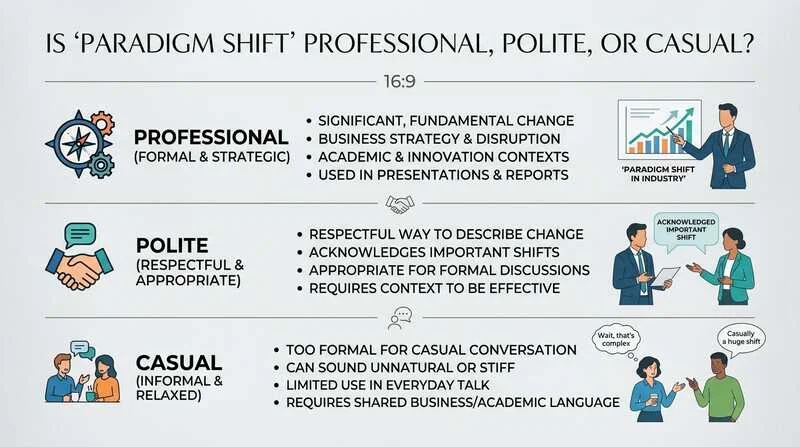
“Paradigm shift” is generally considered professional and intellectual language. It appears frequently in business, academic, and strategic discussions.
The phrase has a formal tone because it suggests deep analysis and large-scale change. It can signal expertise and authority when used correctly.
However, the phrase may sound too dramatic in simple conversations. Some audiences may view it as corporate language if it is used without explaining the actual change.
Tone analysis
- Professional: Strong fit for strategy discussions and presentations.
- Polite: Usually neutral and respectful.
- Casual: Less common; simpler alternatives often feel more natural.
Emotional subtext
Beyond its literal meaning, “paradigm shift” often suggests progress, innovation, disruption, or a challenge to traditional thinking. The listener may expect that the change being discussed is significant.
Pros and Cons of Using “Paradigm Shift”
Advantages
Clarity
The phrase quickly communicates that a change is bigger than a normal adjustment.
Efficiency
It allows speakers and writers to describe complex transformations in only two words.
Accessibility
Despite its formal origin, many audiences understand it in modern professional contexts.
Potential Drawbacks
Oversimplification
The phrase can hide important details if the actual change is not explained.
Tone mismatch
Some audiences may find it too corporate or academic.
Repetition
Using “paradigm shift” too often can make writing feel predictable or exaggerated.
Real-Life Examples of “Paradigm Shift” by Context
A paradigm shift is most effective when describing a situation where the underlying way of thinking changes. The following examples show how native speakers use the phrase naturally in different communication settings.
Email Example
Subject: Updating Our Customer Experience Strategy
“Over the past year, customer expectations have changed significantly. Moving from traditional support methods to AI-assisted service represents a paradigm shift in how companies build relationships with customers. This new approach allows us to provide faster responses while creating more personalized experiences.”
Meeting Example
“Our industry is experiencing a paradigm shift. Customers are no longer comparing brands only by price; they are evaluating convenience, transparency, and overall experience. We need to rethink our strategy to stay competitive.”
Presentation Example
“The growth of renewable energy represents a paradigm shift in how societies approach power production. Instead of relying only on traditional energy sources, organizations are exploring sustainable alternatives that reshape the future of energy.”
Conversation Example
“When I started working remotely, it created a paradigm shift in how I viewed productivity. I realized that results mattered more than simply being present in an office.”
Social Media Example
“Artificial intelligence is creating a paradigm shift in the way people create content, learn new skills, and approach everyday tasks.”
“Paradigm Shift” vs Similar Expressions (Key Differences)
Although many expressions describe change, each phrase carries a slightly different meaning and emotional impact. Choosing the right alternative depends on whether you want to emphasize size, speed, innovation, improvement, or a change in perspective.
| Phrase | Meaning Difference | Tone Difference | Best Use Scenario |
| Paradigm Shift | A fundamental change in thinking, systems, or beliefs | Professional, analytical, strategic | Describing major changes in industries, ideas, or behaviors |
| Transformation | A broad change that creates a new state or condition | Professional, positive, action-focused | Business growth, organizational improvement, and personal development |
| Game Changer | Something that creates a major advantage or changes outcomes | Casual, energetic, promotional | Marketing, technology, products, innovations |
| Turning Point | A specific moment when direction changes | Emotional, storytelling-focused | Personal experiences, history, and important decisions |
| Evolution | A gradual process of development or improvement | Neutral, thoughtful | Long-term trends, gradual progress, natural development |
| Breakthrough | A significant discovery or achievement that solves a problem | Positive, exciting | Science, research, innovation, problem-solving |
Common Mistakes & Misuse of “Paradigm Shift”
The phrase paradigm shift is powerful, but incorrect use can reduce its impact.
Overuse
One common mistake is using “paradigm shift” for every change. A small software update, minor workplace adjustment, or routine improvement is usually not a paradigm shift.
Example of weak usage:
“Our company changed the meeting schedule, creating a paradigm shift.”
A better description would be:
“Our company improved its meeting structure.”
Incorrect Context
The phrase works best for changes in thinking, systems, or approaches. It is less suitable for simple events.
Incorrect:
“The new office furniture created a paradigm shift.”
Better:
“The company’s move toward flexible workspaces created a shift in workplace design.”
Contradictory Usage
A paradigm shift implies meaningful change. Using the phrase while describing something unchanged creates confusion.
Incorrect:
“This is a paradigm shift because we are continuing the same process.”
Cultural Misunderstandings
Some audiences may not connect with academic or corporate language. In international communication, simpler alternatives may create a clearer understanding.
For example:
“A major change in how we work”
may be easier to understand than:
“A paradigm shift in operational philosophy.”
Psychological Reasons People Prefer “Paradigm Shift”
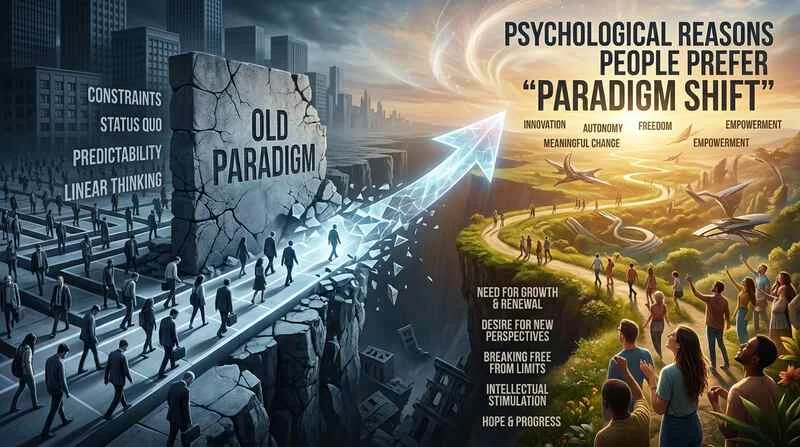
People often choose the phrase paradigm shift because it communicates more than simple change. It creates a sense of importance and helps listeners understand that the situation involves a different way of thinking.
Cognitive Load Reduction
Complex changes often involve many details. The phrase helps summarize a large transformation into a simple concept.
Instead of explaining every change individually, speakers can use “paradigm shift” as a shortcut to communicate the overall impact.
Trust and Authority Signals
In professional environments, the phrase can signal strategic thinking. Leaders, researchers, and consultants often use it when discussing innovation, market changes, or future trends.
However, authority comes from explaining the actual change behind the phrase. Simply using advanced vocabulary does not automatically create credibility.
Attention Economy
Modern audiences process large amounts of information every day. Strong phrases help important ideas stand out.
“Paradigm shift” attracts attention because it suggests that something important has changed.
Modern Communication Habits
Digital communication has increased the popularity of phrases that summarize complex ideas quickly. Professionals often use terms like “paradigm shift” because they allow them to discuss large trends efficiently.
US vs UK Usage of “Paradigm Shift”
The phrase paradigm shift is understood in both American and British English, especially among professionals, academics, and business communities.
US Usage
In the United States, “paradigm shift” is commonly used in:
- Business presentations
- Technology discussions
- Marketing content
- Leadership conversations
American workplace communication often uses the phrase to describe innovation and disruption.
Example:
“The company needs a paradigm shift to compete in the digital marketplace.”
UK Usage
In the UK, the phrase is also recognized but may sometimes sound slightly more formal or academic. British speakers may prefer alternatives like “major change,” “significant shift,” or “new approach” in everyday professional communication.
Example:
“The organization needs a significant change in approach to meet new customer expectations.”
Regional Preference
Both regions understand the phrase, but the audience matters. Executives and specialists may appreciate it, while general audiences may prefer simpler wording.
“Paradigm Shift” in Digital & Modern Communication
Modern communication has increased the use of “paradigm shift” because technology and social changes frequently reshape established systems.
Emails
In professional emails, the phrase works when discussing strategic changes.
Example:
“The adoption of cloud technology represents a paradigm shift in how our teams collaborate.”
For routine updates, clearer alternatives may be better.
Slack / WhatsApp
In quick workplace messages, the phrase may sound too formal.
Instead of:
“This update creates a paradigm shift in our workflow.”
A natural message may be:
“This changes the way we handle tasks moving forward.”
Social Media
On social platforms, “paradigm shift” is often used in thought leadership posts, industry discussions, and educational content.
Example:
“AI is not just another tool; it represents a paradigm shift in how people approach creativity and productivity.”
AI-Generated Summaries
AI tools frequently use “paradigm shift” when summarizing major trends. However, human writers should ensure the phrase accurately reflects the scale of change.
Using simpler language often improves clarity and audience connection.
Linguistic & Communication Insight
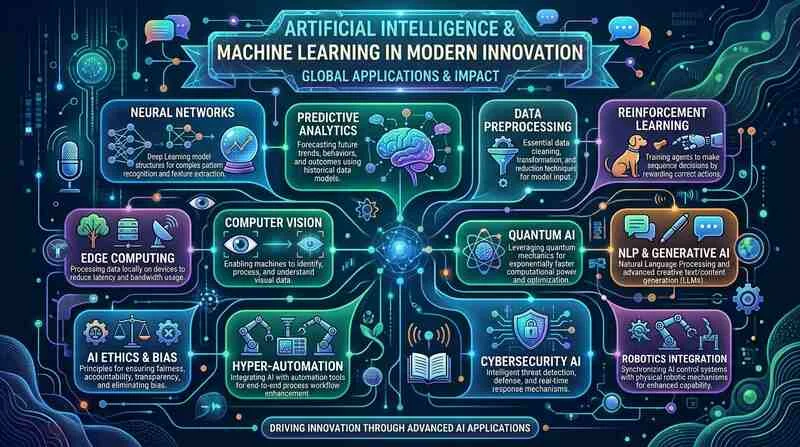
The phrase paradigm shift carries both literal meaning and social meaning. Native speakers usually understand it as a signal that something has changed at a deeper level, not merely improved.
Emotional Weight & Subtext
Beyond the dictionary definition, “paradigm shift” often suggests innovation, disruption, progress, and a departure from traditional thinking.
When a leader says:
“We are experiencing a paradigm shift,”
Listeners often expect a major change that requires adaptation.
The phrase can create excitement, but it may also create pressure because it suggests that old methods are no longer enough.
Direct vs Indirect Phrasing
“Paradigm shift” is a direct way to emphasize significant change.
Compare:
“We need a paradigm shift in our approach.”
This sounds strategic and urgent.
“We may need to explore a new approach.”
This sounds softer and more collaborative.
The first phrase communicates confidence and urgency, while the second encourages discussion and reduces resistance.
Professional Communication Perspective
In workplaces, the phrase can demonstrate strategic awareness when supported by specific examples.
Strong usage:
“The shift toward remote collaboration represents a paradigm shift in workplace culture because teams now measure success through outcomes rather than physical presence.”
Weak usage:
“We need a paradigm shift.”
without explaining what should change.
Pragmatic Reasons for Alternatives
Experienced communicators often choose alternatives because different audiences respond differently.
A CEO speaking to investors may use “paradigm shift” because it communicates strategic importance.
A manager speaking with employees may choose “new approach” because it feels more supportive.
A teacher may use “change in perspective” because it is easier for students to understand.
Social Signaling
Word choice influences how people perceive expertise, confidence, and approachability.
“Paradigm shift” can signal knowledge and strategic thinking, but simpler alternatives can create a stronger connection with broader audiences.
Effective communication is not about choosing the most impressive phrase; it is about choosing the phrase that best matches the audience, purpose, and situation.
Tone & Context Guidance
Use “paradigm shift” when:
- Discussing major changes
- Explaining new systems or beliefs
- Presenting strategic ideas
- Describing long-term transformations
Avoid it when:
- The change is minor
- The audience prefers simple language
- Precision is more important than impact
The strongest communicators understand that clarity is more valuable than complexity.
Comparison Table of 10 Best Alternatives
The following alternatives represent the most useful replacements for “paradigm shift” in different situations. Each option carries a slightly different meaning, tone, and level of formality, allowing writers and speakers to choose language that matches their audience and purpose.
| Phrase | Meaning | Best Use | Worst Use | Tone | US vs UK Usage |
| Fundamental Change | A deep modification that affects the core of a system, idea, or process | Business reports, strategy discussions, professional writing | Minor updates or simple improvements | Professional and direct | Common in both US and UK English |
| Major Transformation | A large-scale change that creates a different condition or outcome | Organizational change, technology, and leadership communication | Small adjustments | Positive and strategic | Widely used in both regions |
| Strategic Shift | A planned change in direction or priorities | Business decisions, market strategies, management discussions | Personal emotional changes | Professional and goal-focused | Especially common in corporate communication |
| Significant Transition | An important movement from one stage to another | Career changes, education, workplace adaptation | Sudden revolutionary changes | Neutral and thoughtful | Common in both varieties of English |
| Change in Approach | A different method or way of handling a situation | Meetings, teamwork, problem-solving | Historic or industry-changing events | Practical and approachable | Natural in both US and UK conversations |
| New Framework | A new structure or system for understanding or operating | Research, education, technology, planning | Informal everyday situations | Analytical and professional | Common among specialists |
| Evolution in Thinking | A gradual development in ideas or perspectives | Education, personal growth, cultural discussions | Sudden disruptive changes | Reflective and intelligent | Used similarly in both regions |
| Transformational Change | A major process that alters how something works | Leadership, organizational development, consulting | Routine improvements | Ambitious and formal | Popular in professional environments |
| Game Changer | Something that dramatically changes the results or competition | Marketing, products, innovation, media | Academic or legal writing | Casual and energetic | More common in US English but understood in the UK |
| Turning Point | A specific moment that changes future direction | Stories, history, personal experiences | Long gradual processes | Emotionally and narratively focused | Common in both regions |
Conclusion
A paradigm shift describes a powerful change in the way people understand, approach, or respond to a situation. Unlike ordinary adjustments, it represents a deeper transformation that influences beliefs, strategies, systems, and behaviors. From scientific discoveries and technological advancements to workplace evolution and cultural changes, paradigm shifts often redefine what people consider possible.
Understanding this phrase helps professionals, students, and writers communicate major changes with accuracy and confidence. However, effective communication depends on choosing language that matches the audience. While “paradigm shift” can express strategic importance, alternatives such as fundamental change, major transformation, strategic shift, or a new approach may sometimes provide greater clarity.
The most successful communicators do not simply use impressive words; they choose expressions that create understanding and connection. Whether describing innovation, personal growth, or industry disruption, recognizing the difference between a simple change and a true paradigm shift allows ideas to be communicated more effectively in modern conversations.
FAQs
What does “paradigm shift” mean in simple words?
A paradigm shift means a major change in the way people think about or understand something. It happens when an old method, belief, or system is replaced by a new perspective. The phrase is often used to describe significant changes in technology, science, business, education, and society.
What is an example of a paradigm shift?
The development of the Internet is a common example of a paradigm shift. It changed how people communicate, access information, work, and conduct business. The change was not only technological but also affected daily habits, industries, and social interactions, creating a completely different way of approaching information and communication.
Is a paradigm shift bigger than a normal change?
Yes, a paradigm shift is usually much larger than a normal change. A regular change may involve updating or improving something, while a paradigm shift affects the underlying way people think, operate, or solve problems. It often creates a new framework that replaces previous assumptions or methods.
Who created the term “paradigm shift”?
The term became popular through philosopher and historian of science Thomas Kuhn in his 1962 book The Structure of Scientific Revolutions. Kuhn used it to explain how scientific communities sometimes replace existing theories with completely new ways of understanding the world.
Is “paradigm shift” a professional phrase?
Yes, “paradigm shift” is considered professional and is commonly used in business, technology, education, and academic discussions. It can demonstrate strategic thinking, but it should be supported with specific details because using it without explanation may sound vague or overly formal.
What are the best synonyms for “paradigm shift”?
Common alternatives for “paradigm shift” include fundamental change, major transformation, strategic shift, transformational change, new framework, turning point, and game changer. The best choice depends on the situation, audience, and the type of change being described.
Can “paradigm shift” be used in everyday conversation?
Yes, but it may sound formal in casual conversations. Many people use simpler expressions such as “a big change,” “a new way of thinking,” or “a turning point” when speaking informally. The phrase works best when discussing important changes in ideas, behaviors, or systems.
How do you use “paradigm shift” in a sentence?
You can use “paradigm shift” when describing a major change in thinking or practice. For example: “Remote work created a paradigm shift in how companies understand productivity and teamwork.” The phrase should describe a meaningful transformation rather than a small improvement or routine update.
Why is “paradigm shift” important in communication?
The phrase is useful because it quickly summarizes a complex transformation. It helps speakers and writers explain that something has changed at a deeper level. In professional communication, it can highlight innovation, strategic changes, and new perspectives when used with clear examples and supporting details.
What is the difference between a paradigm shift and a transformation?
A paradigm shift focuses mainly on a change in thinking, beliefs, or perspective, while transformation focuses more on the process and result of becoming different. A transformation may involve practical changes, whereas a paradigm shift usually suggests that people view or approach something in a completely new way.